

Brushing Alone Doesn’t Tell the Whole Story
When a child keeps getting cavities, I want to know two things beyond how well they brush: Are they sleeping with their mouth open, and how often are they eating or drinking throughout the day?
I meet parents who are brushing their children’s teeth, keeping up with dental visits, and choosing healthy foods. Then they hear, “Two more cavities.” That’s frustrating. And simply telling that family to brush better doesn’t give them a complete answer.
We still check brushing technique and the places that are easy to miss. But brushing is only part of how teeth stay protected. Between brushings, saliva does essential work—and mouth breathing dries out the mouth, weakening that protection.
You can’t out-brush what mouth breathing does to saliva.
Saliva Protects Teeth Between Brushings
If your child brushes for two minutes twice a day, that adds up to four minutes. For the rest of the day, saliva plays an ongoing role in protecting their teeth.
The bacteria in dental plaque use sugars from food and drinks to produce acids. Those acids remove minerals from enamel, the hard outer surface of a tooth. Saliva helps clear sugars and acids, neutralize acidity, and supply minerals that repair early damage. That repair process is called remineralization.
Brushing removes plaque and saliva helps maintain the environment around the teeth between brushings. Both matter. But when the mouth stays dry, that protection weakens and the risk of decay increases.1
Why I Ask About Mouth Breathing
Saliva flow naturally slows during sleep. Breathing through an open mouth adds to nighttime mouth dryness, leaving the teeth with less protection.
Research gives us a reason to pay attention. In a small study of 10 adults, the mouth became more acidic during sleep when participants breathed through their mouths.2 A study of 257 preschoolers found more cavities in the front teeth among children who predominantly breathed through their mouths. Frequent sugar consumption had an even stronger association with decay. These findings support looking at breathing and eating habits together.3
These findings don’t establish mouth breathing as the sole cause of every child’s cavities, but they reinforce why we look at breathing alongside eating habits. If your child regularly sleeps with their mouth open, we want to understand what is making nasal breathing difficult.
Brushing Regularly, but Still Seeing Cavities?
Let’s take a closer look at your child’s teeth, daily habits, and nighttime breathing. Together, we’ll help you understand what’s contributing to recurring cavities and what to address next.
Teeth Need a Break From All-Day Snacks and Sips
The other part of this conversation is what happens during the day.
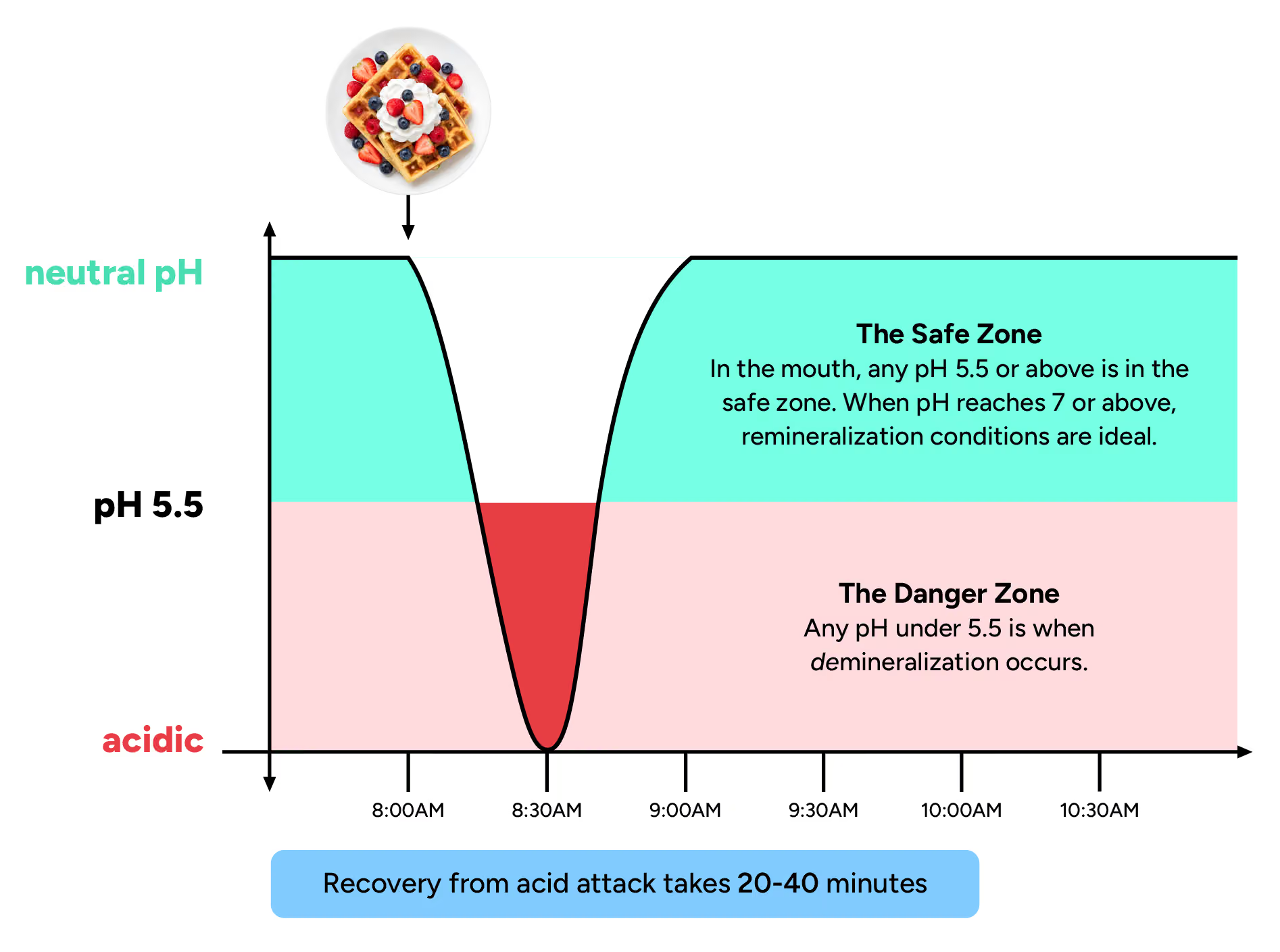
Each time your child eats or drinks something containing sugars or starches, it gives fuel to the bacteria in plaque to produce acids. Repeated exposure means repeated mineral loss. Saliva helps repair early damage, but frequent snacking and sipping keep tipping that balance toward decay.4
A snack eaten at one sitting and the same snack nibbled over several hours create different patterns of exposure. That’s why one of my first questions is, “How many times a day does your child have a snack?”
The Sugar Talk
My dad taught me a family rule he called the “sugar talk.” In our house, eating happened at mealtimes, with a beginning and an end, nothing in between. The lesson I carry into conversations with parents is simple: teeth need breaks.
That means paying attention to both how much sugar your child eats and how often they eat it.5
That includes naturally occurring sugars, too. Parents often tell me, “But it’s organic,” or “It’s just fresh strawberries.” Strawberries still contain sugar, and bacteria in plaque use that sugar to produce acids. The organic label doesn’t change that process.
Whole fruit belongs in a healthy diet. When your child has a snack, apply that same principle: give it a beginning and an end. Serve the strawberries, let your child enjoy them, and offer water between eating times so their teeth have a chance to recover.
What This Looks Like at Home
A few everyday patterns deserve a closer look:
- Sipping all day: Sipping sugary drinks from a bottle or sippy cup throughout the day increases your child’s risk of cavities. The same goes for slowly working through a sweet pouch—that’s a long time for sugar to stay in contact with their teeth.6
- Snacking all day: When your child snacks throughout the afternoon, they’re starting a new acid attack before the last one has settled.
- Crackers and chips stick to teeth: Those cheesy crackers your kids love—as well as chips and cookies—get stuck in the grooves of their teeth longer than you might think. I don’t give my kids those crackers.
- A sweet drink in the bedtime bottle or cup: A sweet drink at bedtime increases the risk of cavities. The sugar stays on your child’s teeth while they sleep, when there’s less saliva to help protect them.6
What We Look at When Cavities Keep Coming Back
When I identify mouth breathing and dry mouth in children who keep getting cavities despite regular brushing and flossing, parents have often cried. Nobody had explained that sleeping with an open mouth dries out the mouth and weakens saliva’s ability to protect their child’s teeth. They’ve been doing what they were told, without understanding why new cavities keep appearing. They’ve only been given half the information about protecting their child’s teeth.
At every Airway Dentists office, we look at the whole routine—from brushing, snacks, and drinks to nighttime breathing. An airway evaluation can include a sleep questionnaire and an examination of your child’s mouth, jaws, and breathing pattern. We use those findings to recommend treatment and coordinate with their pediatrician or an ear, nose, and throat specialist when needed.
Tell us about snoring, restless sleep, or waking with a dry mouth. If your child snores most nights, gasps, or has breathing pauses during sleep, contact their pediatrician soon.
What I Change First
We work on these in order:
- Find out why your child’s mouth is open at night. We start by identifying what’s getting in the way of comfortable nasal breathing, so we can help them breathe through their nose with their lips closed during sleep.
- Make bedtime brushing and flossing consistent. Help your child clean their teeth thoroughly before bed, including the spaces between teeth.
- Stop the all-day grazing and sipping. Plan snack times, keep sweet drinks and treats to meals, and offer water in between. Children under two should avoid added sugar altogether.
Alongside treating existing cavities, we work on the habits and breathing concerns that affect your child’s teeth between visits.
Changes to Make Tonight
If you’re already brushing your child’s teeth consistently, keep that routine and focus on their breathing and eating habits next. Tonight, offer only water after brushing, and skip sweet drinks in a bedtime bottle or cup.
Starting tomorrow, keep sweet drinks and treats at mealtimes, serve snacks at set times, and offer water in between so their teeth get a break.
Let’s Take a Closer Look
If your child keeps getting cavities despite regular brushing, or regularly sleeps with their mouth open, we’ll help you investigate those patterns and build a plan around what we find.
Sources:
- Dawes C. “Salivary flow patterns and the health of hard and soft oral tissues.” Journal of the American Dental Association. 2008;139 Suppl:18S–24S. https://doi.org/10.14219/jada.archive.2008.0351
- Choi JE, Waddell JN, Lyons KM, Kieser JA. “Intraoral pH and temperature during sleep with and without mouth breathing.” Journal of Oral Rehabilitation. 2016;43(5):356–363. https://doi.org/10.1111/joor.12372
- Soares MEC, Ramos-Jorge J, Lima LJS, et al. “Mouth breathing is associated with a higher prevalence of anterior dental caries in preschool children.” Brazilian Oral Research. 2024;38. https://doi.org/10.1590/1807-3107bor-2024.vol38.0057
- National Institute of Dental and Craniofacial Research. “The Tooth Decay Process: How to Reverse It and Avoid a Cavity.” Read source
- van Loveren C. “Sugar Restriction for Caries Prevention: Amount and Frequency. Which Is More Important?” Caries Research. 2019;53(2):168–175. https://doi.org/10.1159/000489571
- American Academy of Pediatric Dentistry. “Policy on Early Childhood Caries: Consequences and Preventive Strategies.” Latest revision: 2025. Read source